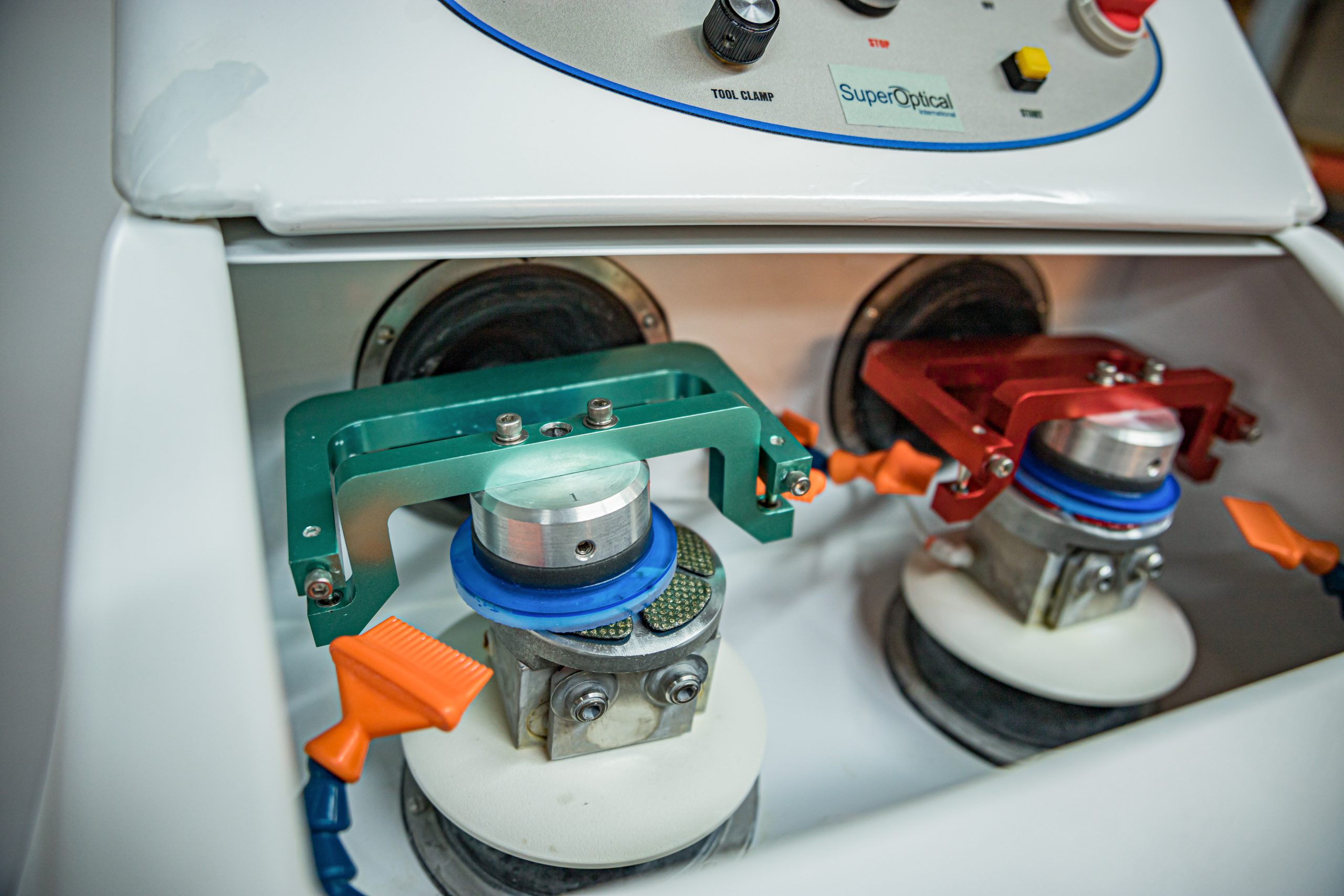
FastGrind Capabilities Overview
This article provides a clear, factual overview of what the FastGrind in-office lens surfacing system can produce today. It is intended as a reference point for independent optical practices evaluating in-office surfacing capabilities. This content focuses on production capability and system boundaries, not laboratory comparisons or profitability discussion.
For broader context on why practices adopt in-office lens surfacing, see Boost Optical Profitability and In-Office Lens Surfacing for Independent Optical.
Lens Categories Supported by FastGrind
These capabilities are centered around three primary lens categories that cover the bulk of routine dispensing needs in an independent practice.
Progressive Lenses
FastGrind is primarily designed to surface digitally enhanced progressive lenses in-office. These lenses are intended for everyday wear and represent the majority of multifocal prescriptions produced on the system.
ADDvantage HD Plus is the primary progressive lens surfaced on FastGrind. It is the default recommendation for most wearers, offering distortion-free distance vision, smooth transitions through the corridor, and a balanced reading area suitable for general use.
Vicuna is an alternative progressive design intended for wearers who spend extended time in the intermediate zone. It provides a wider intermediate area than ADDvantage HD Plus, with the expected trade-off of increased peripheral distance awareness inherent to softer progressive designs.
Bifocal Lenses
FastGrind supports traditional bifocal designs, including FT28-style lenses. These lenses provide a clear optical separation between distance and near vision and are surfaced in-office using the same controlled workflow as progressive lenses.
Single Vision Lenses
FastGrind supports select single vision lenses as a secondary production category. These are primarily prescriptions that cannot be efficiently stocked or dispensed in finished single vision form.
In this context, specialty single vision often refers to lenses such as standard polarized lenses and polarized lenses with solid mirror fronts. These lenses benefit from in-office surfacing because it is not possible to stock polarized lenses with cylinder on axis.
Prescription Range and Design Boundaries
FastGrind operates within a defined prescription range intended to deliver consistent, repeatable results in an in-office environment. This range also defines the core surfacing capabilities for predictable day-to-day production.
- Sphere: approximately -8.50 to +4.00
- Cylinder: -3.00 with standard tool set, expandable to -4.00 at any time with the purchase of additional lap tools
- Add powers: +1.00 to +3.00 in 0.25 increments, lower add powers available in new anti-fatigue design
While some prescriptions outside these ranges may be technically possible, they are not recommended for routine in-office production due to increased variability and reduced repeatability.
Lens Features and Optical Characteristics
Lenses surfaced on FastGrind are digitally enhanced designs executed in-office. Feature characteristics vary by lens design but may include:
- Distortion-free distance vision in primary progressive designs
- Smooth transitions between distance, intermediate, and near zones
- Large reading area to ensure near vision comfort
FastGrind executes defined lens designs rather than dynamically generating proprietary designs on a per-prescription basis. This approach prioritizes predictability, optical consistency, and controlled outcomes.
Capabilities of Materials & Treatments
Super Optical utilizes the VisionAir material for nearly all FastGrind lenses. VisionAir is a premium lens material that is a 1.56 index making it thinner and lighter than traditional CR39 and has a better ABBE Value than polycarbonate for peak optical clarity. VisionAir is also naturally UV filtering for whole eye health.
Available treatments and options include:
- Conversion photochromic lenses, available in Gray and Brown
- BlueShield, an in-monomer blue light filtering technology
- CLARITY AR, premium super hydrophobic anti-reflection coating
- Polarized, available in Gray and Brown with and without Polar+Fire a solid mirror front
Workflow Requirements and Best Practice
FastGrind is designed to best operate using pre-blocked lens blanks supplied by Super Optical. When using approved pre-blocked lens blanks the system software recognizes supported lens options and automatically accounts for design parameters, lap selection, and center thickness requirements. This workflow is central to achieving the system’s intended capabilities in a consistent, repeatable way.
While FastGrind can technically be operated in a manual mode to use third party lenses, it is strongly discouraged. Operating without Super Optical approved pre-blocked lenses requires the practice to invest in alternative blocking, taping, generating, and lab control systems. All costly and space consuming equipment that increases overhead costs while offering no significant benefits. Aside from the additional equipment, the operator would need to independently calculate lap selection for prescription accuracy, calculate run time to manage prism and center thickness control, and manage center thickness. Use of pre-blocked blanks ensures alignment accuracy, repeatability, and consistent optical outcomes while minimizing operator variability.
Operational Boundaries
FastGrind is intended to support the majority of routine multifocal and specialty single vision needs within an independent practice. Certain complex prescriptions, extreme powers, or uncommon constructions may remain better suited for external laboratory production.
The system is not designed for high-volume wholesale lab use and is optimized specifically for controlled, in-office production.
Common Capabilities Questions and Clarifications
Is FastGrind a Freeform Design Engine?
No. FastGrind does not dynamically generate proprietary freeform designs based on individual prescription data. The system produces defined digital lens designs that have been engineered and validated for comfort. Freeform does not inherently indicate quality. Instead, it describes only the process in which the lens was produced. Freeform uses a laser while FastGrind uses proprietary modified surfacing technology.
Can All Prescriptions Be Surfaced In-Office?
No. While FastGrind will produce 85% or more of your multifocal lens needs, there will still be the occasional prescription that falls outside of FastGrind's prescription range. Prescriptions that fall outside the recommended range or require unusual construction are better served by external laboratories.
How Does FastGrind Differ From Laboratory Surfacing?
Laboratories operate on large volume with high capacity systems. Laboratories often require hundreds or thousands of pairs per day to justify the equipment investment.
Will FastGrind Replace my Lab Relationship?
Unlikely. While some businesses report utilizing FastGrind for 100% of their originally outsourced work, businesses should expect a rate closer to 85%. FastGrind is best positioned as a complementary production capability. Most practices continue to rely on laboratories for lenses that fall outside FastGrind’s intended scope.
Positioning FastGrind Within an In-Office Strategy
FastGrind is a focused production system. When used within its defined design and prescription boundaries, it enables reliable in-office surfacing for a meaningful portion of an independent practice’s lens mix.
This overview defines what FastGrind can produce today and where its limits exist, providing a clear foundation for further evaluation and education.